 |
FIMS
v0.11.0
|
|
FIMS
v0.11.0
|
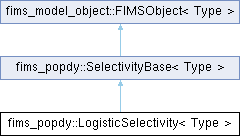
LogisticSelectivity class that returns the logistic function value from fims_math. More...
#include <logistic.hpp>
Public Member Functions | |
| virtual const Type | evaluate (const Type &x) |
| Method of the logistic selectivity class that implements the logistic function from FIMS math. | |
| virtual const Type | evaluate (const Type &x, size_t pos) |
| Method of the logistic selectivity class that implements the logistic function from FIMS math. | |
 Public Member Functions inherited from fims_popdy::SelectivityBase< Type > Public Member Functions inherited from fims_popdy::SelectivityBase< Type > | |
| SelectivityBase () | |
| Constructor. | |
| Public Member Functions inherited from fims_model_object::FIMSObject< Type > | |
| uint32_t | GetId () const |
| Getter that returns the unique id for parameters in the model. | |
| bool | CheckDimensions (size_t actual, size_t expected) |
| Check the dimensions of an object. | |
| Public Member Functions inherited from fims_model_object::FIMSMemoryTracker | |
| void | register_self (const uint32_t id) |
| Registers a FIMSObject instance with the memory tracker. | |
Public Attributes | |
| fims::Vector< Type > | inflection_point |
| The age at which 50% of fish are selected for models that start at age zero and each age bin represents one year. | |
| fims::Vector< Type > | slope |
| How quickly selectivity changes with age around the inflection point, per year of age. Larger absolute values give a steeper, more knife-edge curve; negative values give a curve that declines with age. | |
| Public Attributes inherited from fims_model_object::FIMSObject< Type > | |
| uint32_t | id |
| std::vector< Type * > | parameters |
| std::vector< Type * > | random_effects_parameters |
| std::vector< Type * > | fixed_effects_parameters |
Additional Inherited Members | |
| Static Public Attributes inherited from fims_popdy::SelectivityBase< Type > | |
| static uint32_t | id_g = 0 |
| Static Public Attributes inherited from fims_model_object::FIMSMemoryTracker | |
| static int | total_active_objects = 0 |
| Total number of active FIMSObject instances currently in memory. | |
LogisticSelectivity class that returns the logistic function value from fims_math.
The logistic selectivity function can produce either an ascending or descending curve based on the sign of the slope parameter. A positive slope creates an ascending logistic curve (selectivity increases from 0 to 1 with increasing x), while a negative slope creates a descending logistic curve (selectivity decreases from 1 to 0 with increasing x).
|
inlinevirtual |
Method of the logistic selectivity class that implements the logistic function from FIMS math.
\[ \frac{1.0}{ 1.0 + exp(-1.0 * slope (x - inflection\_point))} \]
The selectivity curve can be either ascending or descending depending on the sign of the slope parameter:
| x | The independent variable in the logistic function (e.g., age or size in selectivity). |
Implements fims_popdy::SelectivityBase< Type >.
|
inlinevirtual |
Method of the logistic selectivity class that implements the logistic function from FIMS math.
\[ \frac{1.0}{ 1.0 + exp(-1.0 * slope (x - inflection\_point))} \]
The selectivity curve can be either ascending or descending depending on the sign of the slope parameter:
| x | The independent variable in the logistic function (e.g., age or size in selectivity). |
| pos | Position index, e.g., which year. If the index is out of bounds then it returns the first element, which would be the case when you do not have time-varying selectivity. |
Implements fims_popdy::SelectivityBase< Type >.
| fims::Vector<Type> fims_popdy::LogisticSelectivity< Type >::inflection_point |
The age at which 50% of fish are selected for models that start at age zero and each age bin represents one year.
The 50% quantile of the value of the quantity of interest (x).
 1.9.8
1.9.8