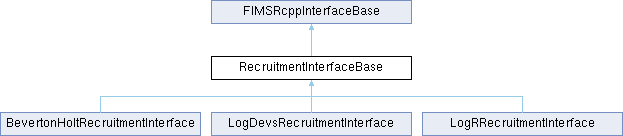
Rcpp interface that serves as the parent class for Rcpp recruitment interfaces. This type should be inherited and not called from R directly.
More...
#include <rcpp_recruitment.hpp>
|
|
| RecruitmentInterfaceBase () |
| | The constructor.
|
| |
| | RecruitmentInterfaceBase (const RecruitmentInterfaceBase &other) |
| | Construct a new Recruitment Interface Base object.
|
| |
|
virtual | ~RecruitmentInterfaceBase () |
| | The destructor.
|
| |
| virtual uint32_t | get_id ()=0 |
| | Get the ID for the child recruitment interface objects to inherit.
|
| |
| virtual double | evaluate_mean (double spawners, double phi_0)=0 |
| | Evaluates expected recruitment from the stock–recruitment relationship before recruitment-process deviations are applied.
|
| |
| virtual bool | add_to_fims_tmb () |
| | A virtual method to inherit to add objects to the TMB model.
|
| |
| virtual void | finalize () |
| | Extracts derived quantities back to the Rcpp interface object from the Information object.
|
| |
| virtual std::string | to_json () |
| | Convert the data to json representation for the output.
|
| |
| std::string | value_to_string (double value) |
| | Report the variable value as a string.
|
| |
|
std::string | make_dimensions (uint32_t start, uint32_t end, uint32_t rep=1) |
| | Make a string of dimensions for the model.
|
| |
Rcpp interface that serves as the parent class for Rcpp recruitment interfaces. This type should be inherited and not called from R directly.
◆ RecruitmentInterfaceBase()
Construct a new Recruitment Interface Base object.
- Parameters
-
◆ evaluate_mean()
| virtual double RecruitmentInterfaceBase::evaluate_mean |
( |
double |
spawners, |
|
|
double |
phi_0 |
|
) |
| |
|
pure virtual |
Evaluates expected recruitment from the stock–recruitment relationship before recruitment-process deviations are applied.
Recruitment is evaluated for the first age represented in the input data. For example, if the weight-at-age and age-composition data start at age 1, recruitment is evaluated for age-1 fish rather than age-0 fish. The recruitment age is not set directly by this function; it is determined by the age structure of the input data.
Recruitment functors that do not define a stock–recruitment mean return the default value of zero.
- Parameters
-
| spawners | Spawning output at the time step being evaluated, such as spawning biomass or another model-specific measure of reproductive output. |
| phi_0 | Spawners per recruit at unfished equilibrium, used to scale the stock–recruitment relationship relative to unfished conditions. |
- Returns
- Expected recruitment before recruitment-process deviations or random effects are applied.
Implemented in BevertonHoltRecruitmentInterface, LogDevsRecruitmentInterface, and LogRRecruitmentInterface.
◆ get_id()
| virtual uint32_t RecruitmentInterfaceBase::get_id |
( |
| ) |
|
|
pure virtual |
The documentation for this class was generated from the following files:

 Public Member Functions inherited from FIMSRcppInterfaceBase
 1.9.8
1.9.8