 |
FIMS
v0.11.0
|
|
FIMS
v0.11.0
|
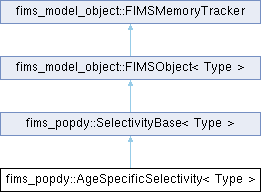
Age-specific selectivity calculated using one parameter per age bin. More...
#include <age_specific.hpp>
Public Member Functions | |
| virtual const Type | evaluate (const Type &x) |
| Calculates selectivity for an age using its age-specific parameter. | |
| virtual const Type | evaluate (const Type &x, size_t pos) |
| Calculates selectivity for an age using its age-specific parameter. | |
 Public Member Functions inherited from fims_popdy::SelectivityBase< Type > Public Member Functions inherited from fims_popdy::SelectivityBase< Type > | |
| SelectivityBase () | |
| Constructor. | |
| Public Member Functions inherited from fims_model_object::FIMSObject< Type > | |
| uint32_t | GetId () const |
| Getter that returns the unique id for parameters in the model. | |
| bool | CheckDimensions (size_t actual, size_t expected) |
| Check the dimensions of an object. | |
| Public Member Functions inherited from fims_model_object::FIMSMemoryTracker | |
| void | register_self (const uint32_t id) |
| Registers a FIMSObject instance with the memory tracker. | |
Public Attributes | |
| fims::Vector< Type > | logit_sel_at_age |
| Stores the age-specific selectivity parameters on the logit scale. | |
| size_t | n_ages |
| Stores the number of modeled age bins. | |
| size_t | min_age |
Minimum modeled age, used to map input age to logit_sel_at_age. | |
| Public Attributes inherited from fims_model_object::FIMSObject< Type > | |
| uint32_t | id |
| std::vector< Type * > | parameters |
| std::vector< Type * > | random_effects_parameters |
| std::vector< Type * > | fixed_effects_parameters |
Additional Inherited Members | |
| Static Public Attributes inherited from fims_popdy::SelectivityBase< Type > | |
| static uint32_t | id_g = 0 |
| Static Public Attributes inherited from fims_model_object::FIMSMemoryTracker | |
| static int | total_active_objects = 0 |
| Total number of active FIMSObject instances currently in memory. | |
Age-specific selectivity calculated using one parameter per age bin.
AgeSpecificSelectivity estimates a separate selectivity value for each age bin. The values stored in logit_sel_at_age are on the logit scale and are transformed to the interval [0, 1]:
\[ s_a = \frac{1}{1 + \exp(-logit\_sel\_at\_age)} \]
where \(logit\_sel\_at\_age\) is the logit-scale parameter for age \(a\) and \(s_a\) is the resulting selectivity.
The parameter at age \(a\) is selected using the zero-based index \(a - min\_age\). Therefore, logit_sel_at_age[0] corresponds to min_age, logit_sel_at_age[1] corresponds to min_age + 1, and so on. The parameter vector should normally contain one element for each age class, with n_ages matching the number of modeled ages.
Age-specific selectivity is highly flexible because it does not impose a smooth parametric curve across ages. This flexibility can create identifiability problems, especially when estimating both selectivity and fishing mortality. Users should ensure that at least one age-specific selectivity parameter is "constant", i.e., not estimated, and is equal to or near 1, or otherwise impose suitable constraints. This can be achieved by setting at least one age-specific parameter (logit_sel_at_age), which are on the logit scale, to a value greater than 10 with estimation_type == "constant".
|
inlinevirtual |
Calculates selectivity for an age using its age-specific parameter.
The input age is converted to a zero-based parameter index by subtracting min_age. This zero-based index, based on x, is then used to select the appropriate element of logit_sel_at_age, which is a logit-scale parameter, and it is transformed to a selectivity value between zero and one using fims_math::inv_logit with lower and upper bounds of zero and one. Consequently, logit_sel_at_age[0] corresponds to min_age, and each subsequent element corresponds to the next modeled age.
| x | The age at which selectivity is evaluated. The value is expected to be an integer-valued age greater than or equal to min_age. |
x. | std::invalid_argument | if the calculated age index is outside logit_sel_at_age. |
Implements fims_popdy::SelectivityBase< Type >.
|
inlinevirtual |
Calculates selectivity for an age using its age-specific parameter.
The input age is converted to a zero-based parameter index by subtracting min_age. This zero-based index, based on x, is then used to select the appropriate element of logit_sel_at_age, which is a logit-scale parameter, and it is transformed to a selectivity value between zero and one using fims_math::inv_logit with lower and upper bounds of zero and one. Consequently, logit_sel_at_age[0] corresponds to min_age, and each subsequent element corresponds to the next modeled age.
| x | The age at which selectivity is evaluated. The value is expected to be an integer-valued age greater than or equal to min_age. |
x. | std::invalid_argument | if the calculated age index is outside logit_sel_at_age. |
| pos | Position index, e.g., which year. |
logit_sel_at_age can hold 1 value for all ages and years, n_ages values used in every year, or n_ages values per year (age within year). Any other length is an input error and throws std::invalid_argument, rather than silently reusing values for the wrong ages.
Implements fims_popdy::SelectivityBase< Type >.
| fims::Vector<Type> fims_popdy::AgeSpecificSelectivity< Type >::logit_sel_at_age |
Stores the age-specific selectivity parameters on the logit scale.
Each element corresponds to one modeled age, beginning with min_age.
 1.9.8
1.9.8